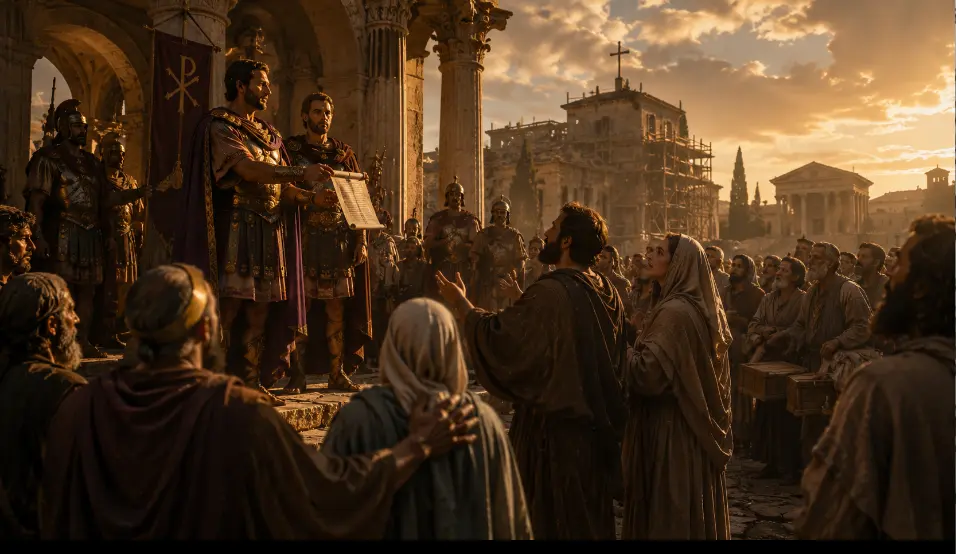
What traditions of men have we mistaken for the commandments of God?
That is where Chapter Six left us.
And that is where Chapter Seven must begin.
Because once the veil tears and the eyes begin to open, the next thing we must examine is not Rome first.
Not Athanasius first.
Not Arius first.
Not the shelf first.
Us.
Our traditions.
Our assumptions.
Our inherited religious reflexes.
The things we were handed and never tested.
The things we repeated and never examined.
The things we called holy because everyone around us called them holy first.
That is uncomfortable.
Good.
Truth was never sent to comfort the lie.
Jesus confronted the traditions of men because tradition can become one of the most powerful hiding places for dead religion.
Not all tradition is evil.
Some traditions carry wisdom.
Some traditions preserve memory.
Some traditions teach discipline, reverence, gratitude, and remembrance.
But tradition becomes dangerous the moment it rises above truth.
Tradition becomes dangerous the moment it replaces obedience to God.
Tradition becomes dangerous the moment people defend it harder than they seek the Father.
Tradition becomes dangerous the moment it becomes a costume for a life that no longer carries the power of God.
Scripture warned us about this.
Paul spoke of people “having a form of godliness, but denying the power thereof.” [2 Timothy 3:5]
A form.
A shape.
A resemblance.
A religious outline.
It looks like godliness.
It sounds like godliness.
It carries the costume.
But the power is denied.
That is one of the most dangerous veils of all:
The resemblance of God without the power of God.
Words that sound right.
Buildings that look sacred.
Rituals that feel ancient.
Songs that stir emotion.
Titles that command respect.
Traditions that appear safe.
But underneath the form, the power is missing.
The freedom is missing.
The transformation is missing.
The life is missing.
The truth is missing.
The breath is missing.
So we ask:
If the form is there, but the freedom is missing, what are we actually looking at?
If the language is holy, but the people remain bound, what power is being served?
If the building is full, but the hearts are asleep, what god is being worshiped?
If the system claims Christ but denies the liberty Christ opened, is it the Kingdom?
Or only the costume?
That question must stay on the table.
Because dead religion does not always look dead.
Sometimes it looks respectable.
Sometimes it looks familiar.
Sometimes it looks safe.
Sometimes it looks exactly like what we were taught to call faith.
That is why it is dangerous.
A corpse dressed in holy clothing is still a corpse.
A cage decorated with Scripture is still a cage.
A system that uses the name of Christ while keeping people afraid, dependent, and spiritually asleep is not the Kingdom.
It is only the costume.
The Kingdom does not merely resemble life.
The Kingdom carries life.
The Kingdom does not keep sons and daughters crawling outside a veil Jesus already tore.
The Kingdom does not train believers to fear truth.
The Kingdom does not use the name of Christ to produce bondage.
The Kingdom does not silence honest seeking.
The Kingdom does not protect idols.
The Kingdom exposes them.
So let the costume be tested.
Let the form be examined.
Let the fruit speak.
Because not everything wearing holy clothing belongs to the Kingdom.
Jesus showed us this clearly.
He did not attack people because they had tradition.
He attacked tradition when it replaced the command of God.
He confronted religious leaders who honored God with their lips while their hearts stayed far from Him. [Isaiah 29:13; Matthew 15:7–9; Mark 7:6–7]
He exposed people who taught human rules as if they were divine commands. [Mark 7:7–13]
He warned against religious performance done for appearance. [Matthew 6:1–6; Matthew 23:5]
He rebuked leaders who looked clean on the outside while being full of uncleanness within. [Matthew 23:25–28]
He called out those who shut the Kingdom of Heaven in people’s faces. [Matthew 23:13]
Pause there.
They shut the Kingdom in people’s faces.
That means religious authority can stand in front of the door and block what God has opened.
That means men can speak the language of heaven while preventing people from entering the life of heaven.
That means the problem is not always outside religion.
Sometimes the problem is religion without God’s heart.
Sometimes the curtain is not held by pagans.
Sometimes the curtain is held by the people who claim to guard the holy place.
That is what Jesus exposed.
And He did not whisper.
He hit the idol in the mouth.
He called the thing what it was.
Hypocrisy.
Blindness.
Dead performance.
Heavy burdens.
Clean cups outside, corruption inside.
Whitewashed tombs.
Beautiful on the surface.
Dead underneath.
That is costume religion.
That is form without power.
That is the Kingdom’s language being worn by something that does not carry the Kingdom’s life.
And it did not end in the first century.
The same spirit still works.
It works every time people are taught to fear questions more than they fear deception.
It works every time tradition is protected while truth is ignored.
It works every time religious activity becomes a substitute for knowing God.
It works every time people measure faith by appearance while the heart stays far from the Father.
It works every time men build a box for God, then accuse seekers of rebellion for asking who built the box.
That is why we must test the traditions of men.
Not to destroy everything old.
Not to mock our fathers.
Not to spit on history.
Not to dishonor sincere believers who came before us.
But to separate living truth from dead inheritance.
Some things were handed down because they were faithful.
Some things were handed down because they were useful to control.
Some things were preserved because they pointed to God.
Some things survived because powerful men protected them.
Some traditions carry light.
Some traditions carry chains.
The seeker must learn the difference.
Jesus said we would know them by their fruit. [Matthew 7:15–20]
Not merely by their labels.
Not merely by their robes.
Not merely by their creeds.
Not merely by their buildings.
Not merely by their vocabulary.
Fruit.
Does it produce love?
Does it produce truth?
Does it produce freedom?
Does it produce mercy?
Does it produce justice?
Does it produce humility?
Does it produce life?
Does it lead sons and daughters to the Father?
Or does it produce fear, shame, dependence, silence, control, and spiritual sleep?
That is how we test the costume.
Because a thing can look religious and still deny the power.
A thing can use the name of God and still block the way to God.
A thing can quote Scripture and still resist the Spirit of truth.
A thing can call itself church and still become a curtain.
That should sober us.
Because this chapter is not only about them.
It is about us.
It is about the parts of us that like the costume.
The parts of us that enjoy appearing faithful without being transformed.
The parts of us that prefer being approved by men over being corrected by God.
The parts of us that defend familiar lies because truth would require change.
The parts of us that say we want freedom but keep returning to the cage because the cage is known.
That is why the traditions of men are so powerful.
They do not always feel like chains.
Sometimes they feel like home.
Sometimes they feel like safety.
Sometimes they feel like loyalty.
Sometimes they feel like identity.
Sometimes they feel like faithfulness.
But if a tradition keeps us blind, it is not holy.
If a tradition replaces obedience to God, it is not holy.
If a tradition keeps people dependent on men instead of leading them to the Father, it is not holy.
If a tradition protects the curtain Jesus tore, it is not holy.
It is costume.
And costume must bow to Kingdom.
Isaiah saw this sickness before Jesus quoted him.
The people came near with their mouths.
They honored God with their lips.
But their hearts were far from Him.
Their worship had become human commandment taught by men. [Isaiah 29:13]
That is terrifying.
Because it means people can sound near while being far.
They can worship with lips while the heart is absent.
They can inherit the right language and still miss the living God.
They can be trained in religion and still be distant from the True One.
Jesus pulled Isaiah into His own confrontation.
He said the people were leaving the commandment of God and holding to the tradition of men. [Mark 7:8]
That is the indictment.
Not tradition beside truth.
Tradition over truth.
Not custom serving God.
Custom replacing God.
Not remembrance leading to obedience.
Remembrance becoming an excuse to avoid obedience.
That is when tradition becomes rebellion wearing a holy costume.
And God does not bow to costumes.
He is not impressed by religious theater.
Isaiah 1 makes this even harder.
God rejected empty offerings.
He rejected meaningless assemblies.
He said He could not bear iniquity joined with solemn worship.
He called the people to wash themselves, cease evil, learn to do good, seek justice, correct oppression, defend the fatherless, and plead for the widow. [Isaiah 1:13–17]
That is the heart of God.
Not ritual without righteousness.
Not worship without justice.
Not prayers covering oppression.
Not assemblies hiding corruption.
Not religious noise while the vulnerable are ignored.
So let us say it plainly:
God does not hate worship.
He hates worship that lies.
He hates the song that covers injustice.
He hates the prayer that protects oppression.
He hates the fast that feeds pride.
He hates the offering that becomes a costume for corruption.
He hates religious performance that keeps the heart far from Him.
This is not anti-God.
This is the heart of God confronting dead religion.
This is the True One refusing to be reduced to theater.
And this is where many modern believers must tremble.
Because dead religion does not only live in ancient temples.
It lives wherever people perform holiness while resisting transformation.
It lives wherever people speak of God while refusing mercy.
It lives wherever people defend doctrine while neglecting justice.
It lives wherever people use worship to avoid obedience.
It lives wherever people say “Lord, Lord,” while never knowing Him.
Jesus warned about that.
Not everyone who says, “Lord, Lord,” will enter the Kingdom. [Matthew 7:21–23]
That line should shake the dust out of every sleeping soul.
Because the people in that warning are not atheists.
They are not people with no religious language.
They call Him Lord.
They point to works done in His name.
They appear spiritually active.
But Jesus says, “I never knew you.”
That is the horror of costume religion.
It can look active while being unknown.
It can look powerful while denying the true power.
It can do religious things while missing relationship.
It can produce activity without intimacy.
It can produce noise without obedience.
It can produce appearance without life.
And the final question is not, “Did men approve you?”
The final question is not, “Did you wear the costume well?”
The final question is not, “Did you stay inside the approved performance?”
The question is:
Do you know Him?
And does He know you?
That is why Project Unveiled refuses to worship the costume.
We are not tearing down faith.
We are tearing down false gods dressed in faith’s clothing.
We are not removing Jesus.
We are removing the veil that kept people from seeing Him clearly.
We are not replacing God.
We are calling people back to the True One whose breath gives life.
We are not attacking sincere believers.
We are waking them up.
Because truth does not come to destroy the son.
Truth comes to break the chains that made the son forget who he was.
The traditions of men must be tested because the children of God were not created to live under false identity.
They were not created to crawl outside the door.
They were not created to perform for approval from systems that profit from their fear.
They were not created to worship the shelf.
They were not created to mistake the curtain for God.
They were not created to dress like the Kingdom while never entering its life.
They were made to seek.
They were made to see.
They were made to know truth.
They were made to walk free.
So we ask:
What tradition taught us to fear freedom?
What tradition taught us to distrust the voice of the Father?
What tradition taught us that God was far away after Christ opened the way?
What tradition taught us that religious approval equals relationship?
What tradition taught us that questions are rebellion?
What tradition taught us to call spiritual sleep obedience?
What tradition taught us to wear the costume and call it Kingdom?
These questions are not attacks on God.
They are attacks on the lie.
They are attacks on the costume.
They are attacks on the veil.
And every lie must be brought into the light.
Because once a lie is exposed, it loses the power of invisibility.
Once the costume is named, it can be removed.
Once the false god is seen, it can fall.
Once the tradition is tested, it can either stand as truth or burn as bondage.
That is the mercy of exposure.
Hard truth is not cruelty when it leads people back to life.
Jesus was not cruel when He exposed hypocrisy.
He was merciful to the people being crushed under it.
He was not hateful when He confronted religious blindness.
He was loving the ones who had been kept in darkness.
He was not destroying faith.
He was destroying the false gods that had taken faith captive.
That is the line we must walk.
Hard against the idol.
Tender toward the captive.
Sharp against the lie.
Life-giving toward the one trapped inside it.
We hit the costume in the mouth.
But we call the person wearing it back to the Father.
Because the person is not the enemy.
The lie is.
The false god is.
The dead tradition is.
The curtain is.
The form without power is.
And the power of God is not dead.
The power of God still opens blind eyes.
The power of God still tears veils.
The power of God still wakes sleepers.
The power of God still breaks chains.
The power of God still calls sons and daughters home.
The power of God still exposes idols.
The power of God still brings life where religion produced death.
That is why form without power is unacceptable.
Because the Kingdom is not costume.
The Kingdom is life.
The Kingdom is truth.
The Kingdom is righteousness, peace, and joy in the Holy Spirit. [Romans 14:17]
The Kingdom is not owned by empire.
The Kingdom is not trapped in institutions.
The Kingdom is not reduced to traditions of men.
The Kingdom is not a performance.
The Kingdom is not a mask.
The Kingdom is not a dead system wearing holy words.
The Kingdom is the reign of the True One.
And anything claiming the name of the Kingdom must be tested by the life of the King.
Does it look like Jesus?
Does it sound like Jesus?
Does it free like Jesus?
Does it heal like Jesus?
Does it confront hypocrisy like Jesus?
Does it lift the broken like Jesus?
Does it tear veils like Jesus?
Does it lead people to the Father like Jesus?
If not, then why are we bowing to it?
Why are we defending it?
Why are we afraid to test it?
Why are we calling it holy just because it is old?
Why are we protecting the costume when Christ came to bring the Kingdom?
That is the cold hard truth:
A tradition can become a false god.
A form can deny the power.
A costume can imitate the Kingdom.
A religious system can speak the name of Jesus while resisting the freedom Jesus opened.
And when that happens, the veil is not gone.
It has only changed clothes.
So tear it.
Tear the veil of dead tradition.
Tear the veil of inherited performance.
Tear the veil of form without power.
Tear the veil of religion that honors with lips while the heart stays far away.
Tear the veil of “Lord, Lord” without knowing Him.
Tear the veil of worship that ignores justice.
Tear the veil of costumes pretending to be Kingdom.
And when the veil falls, do not run into emptiness.
Run to the True One.
Run to the Father.
Run to the Christ who opened the way.
Run to the breath that gives life.
Run to the truth that makes men free.
Because God is not asking for a costume.
He is calling for sons and daughters.
He is not impressed by appearance.
He is after the heart.
He does not need dead religion defending His name.
He wants living witnesses carrying His life.
So let the costume fall.
Let the Kingdom come.
And let every tradition of men be tested by the truth of God.