“And ye shall know the truth, and the truth shall make you free.” — John 8:32
If the truth makes us free, then why are so many people afraid to seek it?
That is the first question.
Not an attack. Not a rebellion against God. Not an attempt to remove Jesus from the throne.
A question.
And if truth is really truth, then a question should not scare it.
Truth does not tremble when investigated. Truth does not hide when examined. Truth does not need threats, fear, censorship, or punishment to remain true.
A lie needs protection.
Truth needs light.
That is where this book begins.
Not with hate. Not with bitterness. Not with a desire to tear down sincere faith.
This book begins with a simple conviction:
Jesus did not say, “Stay comfortable.”
He did not say, “Never ask hard questions.”
He did not say, “Accept whatever religious power hands you and call that faith.”
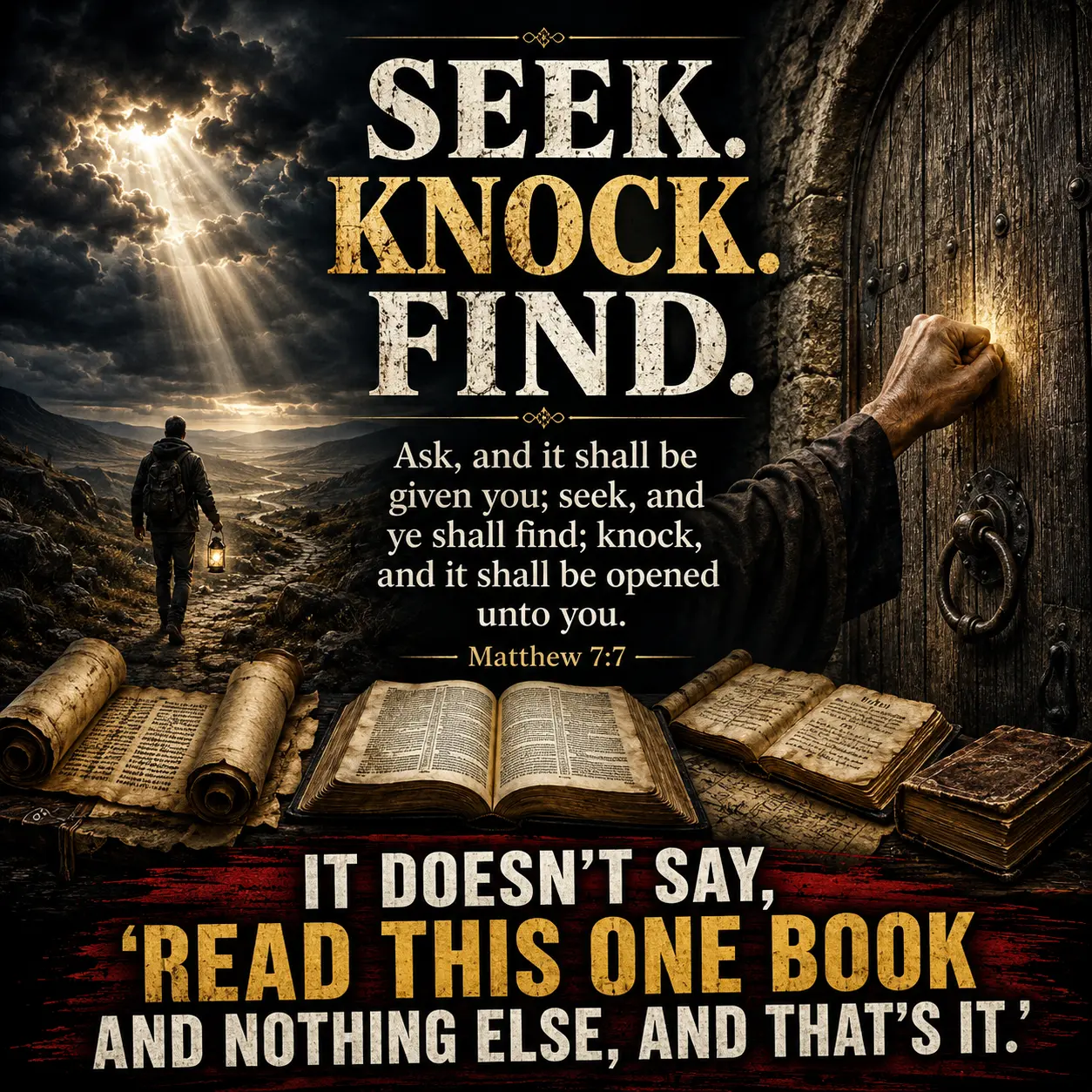
He said to seek.
He said to ask.
He said to knock.
He said the truth would make us free.
So why have so many believers been trained to fear the very act of seeking?
Why are questions treated like rebellion?
Why is curiosity treated like danger?
Why do so many Christians feel guilty for asking what happened, who decided it, who benefited from it, and what was buried along the way?
Those are not faithless questions.
Those are honest questions.
And honest questions belong in the house of truth.
This book is not written to remove Jesus.
Let that be understood clearly from the beginning.
This book is not written to replace God.
It is not written to mock believers, insult the church, or destroy anyone’s relationship with Christ.
It is written to challenge spiritual sleep.
It is written to call complacent Christians back to the command Jesus already gave.
Seek.
Ask.
Knock.
Find.
Because somewhere along the way, many people stopped seeking and started repeating.
They stopped knocking and started accepting locked doors.
They stopped asking and started confusing silence with holiness.
They stopped testing things and started calling tradition truth.
But tradition is not always truth.
Popularity is not always truth.
Survival is not always truth.
A belief does not become pure simply because it lasted.
A version of history does not become complete simply because it was approved.
A doctrine does not become unquestionable simply because powerful men protected it.
Truth is not determined by who had the biggest army.
Truth is not determined by who controlled the books.
Truth is not determined by who had the authority to silence other voices.
Truth is truth.
Before Rome, truth was truth.
Before councils, truth was truth.
Before creeds, truth was truth.
Before canon lists, truth was truth.
Before emperors, bishops, priests, scholars, denominations, printing presses, seminaries, and church buildings, truth was still truth.
And if Jesus said, “I am the way, the truth, and the life,” then truth cannot be owned by empire.
It cannot be chained to politics.
It cannot be reduced to whatever version of the story survived the machinery of power.
That does not mean everything outside the approved version is automatically true.
That would be foolish.
But it also does not mean everything buried, banned, burned, mocked, or labeled dangerous was automatically false.
That would be equally foolish.
This is where honest people must slow down.
We do not need to believe every hidden thing.
We do not need to chase every theory.
We do not need to swallow every claim just because it sounds mysterious.
But we also do not need to be afraid of looking.
We do not need to be afraid of learning.
We do not need to be afraid of asking whether history was cleaner, simpler, and safer in the version we were handed than it was in real life.
Because real history is rarely clean.
Power has always wanted a seat at the table of religion.
Empire has always understood the usefulness of controlled belief.
A people who believe what they are told, fear what they are told to fear, and obey what they are told to obey are much easier to govern than a people who seek truth for themselves.
That is not an attack on faith.
That is a fact about power.
Power likes religion when religion can be organized.
Power likes religion when it can be registered, managed, funded, taxed, standardized, and used to keep order.
Power does not fear ceremonies.
Power does not fear buildings.
Power does not fear people gathering at approved times to repeat approved words under approved authority.
What power fears is awakening.
It fears the man who realizes God is not owned by the system.
It fears the woman who starts asking why truth needs permission.
It fears the seeker who knocks on doors no one told him he was allowed to approach.
It fears the believer who understands that obedience to God and obedience to religious machinery are not always the same thing.
That kind of person is hard to control.
That kind of person is dangerous to empire.
Not because he is violent.
Not because he is lawless.
Not because he hates God.
But because he is awake.
A person who truly seeks truth cannot be easily herded by fear.
A person who knows Jesus as truth cannot be satisfied with secondhand slogans forever.
A person who believes truth makes men free will eventually begin asking why so many religious systems seem built to keep men afraid.
That is the tension this book will explore.
Not by demanding a conclusion.
Not by telling you what you must believe.
But by placing facts on the table and asking the questions that follow.
If Jesus told people to seek, why were so many seekers condemned?
If truth is from God, why would truth need the sword of Rome to protect it?
If the message of Christ was liberation, why did empire work so hard to manage it?
If God is truth, why are believers so often warned not to investigate?
If the foundation is solid, why fear the shovel?
These questions matter.
They matter because faith without truth becomes performance.
Religion without seeking becomes routine.
Obedience without discernment becomes slavery wearing holy language.
And a church that fears questions may not be protecting God.
It may be protecting itself.
That is hard to say.
But some things must be said.
The goal is not to lead people away from Jesus.
The goal is to lead people back to Him with their eyes open.
Back to the One who said truth sets free.
Back to the One who told us to seek.
Back to the One who never needed Rome’s permission to be Lord.
Back to the One who stood above every empire, every temple system, every corrupt authority, every religious performance, and every false burden placed on the backs of men.
Jesus did not come to put people deeper into bondage.
He came to set captives free.
So when any system uses His name while producing fear, control, censorship, complacency, or spiritual dependence on men, we have the right to ask questions.
Not only the right.
The responsibility.
Because truth is not fragile.
Truth is not weak.
Truth is not offended by honest examination.
Truth does not need darkness to survive.
Only lies need darkness.
Only control needs silence.
Only fear needs forbidden questions.
So let the questions come.
Let history speak.
Let the facts stand.
Let the reader think.
Let the seeker seek.
If something is true, it will remain true after investigation.
If something is false, then no amount of tradition can save it.
And if Jesus is the truth, then no honest search can destroy Him.
It can only bring us closer.
This is not rebellion against truth.
This is rebellion against spiritual sleep.
And it begins with one simple question:
why would anyone who claims to serve truth be afraid of us finding it?