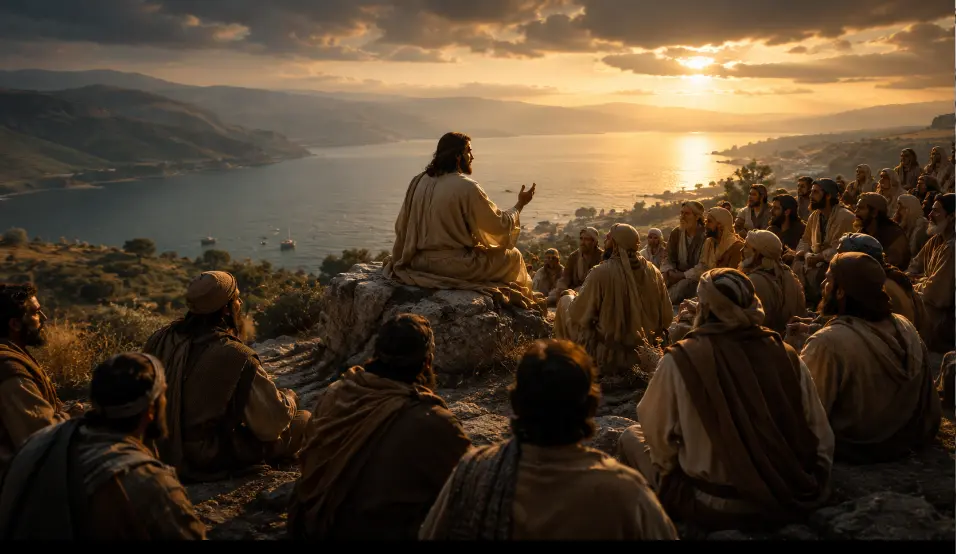
“How do you keep a nation under your rule? You keep the poor poor, and you keep the people ignorant.” Author unknown — attribution unverified
That line may not have a known author.
But the question behind it has followed mankind for thousands of years.
How do you control people?
You do not start by putting chains on their wrists.
You start by putting boundaries around their minds.
You teach them what they are allowed to ask.
You teach them who they are allowed to trust.
You teach them which doors they are allowed to knock on.
You teach them that seeking too far is dangerous.
You teach them that obedience to the system is the same thing as obedience to God.
But before Christianity became a system, it was called something else.
It was called the Way.
Before cathedrals, councils, imperial creeds, political protection, denominational labels, and state-approved religion, the followers of Jesus were known as people belonging to the Way.
That matters.
Because a way is not just a belief.
A way is a path.
A way is movement.
A way is something walked.
It is not merely something repeated from a pulpit, memorized from a page, or enforced by an institution.
A way requires seeking.
A way requires steps.
A way requires a person to move.
When did following Jesus become confused with obeying every man-made structure that claimed to speak for Him?
The book of Acts gives us a serious clue.
Acts says Saul was “breathing threats and murder” against the disciples of the Lord. He went to the high priest and asked for letters to the synagogues in Damascus, so that if he found any who belonged to “the Way,” men or women, he could bring them bound to Jerusalem.
That is not a small detail.
Before Saul became Paul the apostle, he was a persecutor of the Way.
Before he preached freedom in Christ, he helped hunt the people walking the path.
Before he became one of the most influential voices in Christian history, he stood on the side of religious power trying to crush a movement it considered dangerous.
So we have to ask:
What was so dangerous about the Way?
Why did it threaten the religious order?
Why did men and women have to be bound, dragged back, imprisoned, and silenced?
Was it because they hated God?
Or was it because they were following God outside the approved control structure?
Paul later admitted it plainly.
He said, “I persecuted this Way to the death.”
That sentence should stop us cold.
Because it shows that persecution did not begin only with Rome.
Before the empire hunted Christians, religious authority had already hunted the Way.
That does not mean every religious leader was evil.
That does not mean every tradition was false.
But it does mean something uncomfortable:
That is not theory.
That is Paul’s own story.
And if Paul could be sincerely wrong while believing he was serving God, then we must ask another question:
Can religious people still be sincerely wrong today?
Can a person defend tradition and still miss truth?
Can a person protect the system and still oppose the Way?
Can zeal without truth become a weapon?
These are not comfortable questions.
But truth was never promised to be comfortable.
Then Rome enters the story.
At first, Rome did not protect Christianity.
Rome persecuted it.
The early followers of Jesus were not born into political safety. They were not handed seats of honor. They were not protected by imperial law. They were a strange, stubborn, spreading people whose loyalty belonged to a kingdom Rome did not control.
That alone made them dangerous.
Because empire can tolerate religion that stays in its assigned place.
Empire can tolerate ritual.
Empire can tolerate temples.
Empire can tolerate ceremonies.
Empire can tolerate gods that bless the empire, protect the empire, and never question the empire.
But the Way was different.
The Way said there was a King above Caesar.
The Way said truth was not owned by Rome.
The Way said the poor had dignity.
The Way said the slave and the master stood before the same God.
The Way said the body could be killed, but the soul belonged to God.
The Way said freedom began inside a man before any empire could grant or remove it.
How does an empire control people who believe that?
How does an empire rule people who believe truth stands above law?
How does an empire frighten people who believe death is not the final authority?
That is the problem Rome faced.
And when a movement cannot be easily controlled, power has two choices.
It can crush it.
Or it can capture it.
At first, Rome tried pressure.
Later, Rome learned management.
That is where history becomes dangerous.
Because the same empire that once persecuted the followers of Jesus eventually placed itself inside the Christian story.
The question is not whether Jesus is truth.
The question is what happened when empire realized the power of His name.
What happens when the persecutor stops killing the movement and starts organizing it?
What happens when the empire that once feared the Way begins approving the official version of the faith?
What happens when political power learns that religion can do what swords cannot?
A sword can force behavior.
But controlled belief can shape generations.
A sword can threaten the body.
But managed religion can train the conscience.
A sword can make a man kneel.
But controlled doctrine can make him believe kneeling was his own idea.
That is why this matters.
This is not about attacking Jesus.
This is about asking what men did with His name.
This is not about removing God.
This is about questioning the systems that claimed to own access to Him.
This is not about destroying faith.
This is about waking it up.
Because the first followers were not called members of an empire-approved institution.
They were called followers of the Way.
Or are we defending the machine that replaced it?
The Pivot: From Persecution to Permission
At first, Rome did not embrace the followers of Jesus.
Rome feared them.
Not always everywhere. Not every emperor. Not every year. History is rarely that simple.
But the record is clear enough.
There were seasons when Rome saw the followers of Jesus as a threat to public order, imperial loyalty, and the religious unity of the empire. Christians would not worship Caesar as divine. They would not treat Rome’s gods as supreme. They belonged to a kingdom Rome could not tax, command, or fully understand.
That made them dangerous.
Nero used Christians as scapegoats after the Great Fire of Rome in 64 CE, and Roman historian Tacitus records that Christians were punished under Nero’s rule.
Later persecutions were not constant, but they did happen. Under Decius around 250 CE, Rome pushed empire-wide sacrifice as a test of loyalty.
Under Diocletian beginning in 303 CE, Christians faced the last and most severe imperial persecution, including orders against churches, sacred writings, rights, and public Christian identity.
So we have to ask:
If the Way was harmless to empire, why did empire keep trying to force it into submission?
If these believers were merely practicing private religion, why did Rome treat their loyalty as a political problem?
If their kingdom was not of this world, why did the kingdoms of this world feel threatened by them?
The answer may be simple.
Rome did not fear religion.
Rome was full of religion.
Rome feared a loyalty higher than Rome.
That is the difference.
A man can bow in a temple and still serve Caesar.
A man can attend a ceremony and still obey the machine.
A man can repeat religious words and still remain useful to power.
But a man who believes Jesus is Lord has already made a political statement whether he realizes it or not.
Because if Jesus is Lord, Caesar is not ultimate.
If truth makes men free, then fear loses power.
If the Kingdom of God is real, then Rome is temporary.
That kind of faith cannot be easily managed.
So Rome did what power often does.
First, it pressured.
Then it punished.
Then it watched.
And eventually, it adapted.
Because persecution did not destroy the Way.
The movement kept spreading.
The blood, prisons, accusations, and fear did not erase it.
So the empire faced a new question:
What do you do with a movement you cannot kill?
You study it.
You legalize it.
You organize it.
You place yourself close to it.
You stop treating it only as an enemy and begin treating it as an asset.
That is the pivot.
In 313 CE, Constantine and Licinius issued what is known as the Edict of Milan. It did not make Christianity the only religion of the empire, but it did give Christians legal protection, freedom to worship, and the return of confiscated property.
It moved Christianity from persecuted faith toward legally recognized and protected religion.
That was not a small change.
One generation earlier, Christians could be hunted.
Now the empire was restoring church property.
So we must ask:
What changed?
Did Rome suddenly become humble before the truth?
Or did Rome recognize that Christianity had become too powerful to destroy and too useful to ignore?
Did the empire repent?
Or did the empire adjust strategy?
Those questions matter.
Because when Rome stopped attacking Christianity from the outside, another danger appeared.
Rome could now influence Christianity from the inside.
A persecuted movement has one kind of danger.
A protected religion has another.
When power persecutes faith, believers know the enemy is outside the gate.
But when power sponsors faith, funds it, protects it, organizes it, and gives it legal favor, the danger becomes harder to see.
It simply moves closer to the altar.
The empire that once pressured Christians to bow now had reason to shape what Christianity would become.
That does not mean Jesus changed.
That does not mean God changed.
That does not mean every Christian leader was corrupt.
But it does mean the relationship between faith and power changed forever.
Before, the question was:
Will Rome destroy the followers of Jesus?
After Constantine, the question became:
What will Rome do with the name of Jesus?
That is the question history forces us to face.
Because by 380 CE, under Theodosius, Nicene Christianity was no longer merely protected. The Edict of Thessalonica threatened imperial consequences for those who rejected the Nicene creed.
After that, truth was no longer only debated in churches. It became tied to the machinery of the state.
So the story moves from persecution to permission.
From permission to preference.
From preference to enforcement.
And once belief becomes enforceable by law, we must ask the question no honest seeker can ignore:
Or is power protecting the version of truth that protects power?
This is where the road turns.
This is where the Way begins to meet the machine.
And this is where we must look carefully—not to remove Jesus, not to replace God, not to destroy faith—but to ask what happened when the empire that once feared the followers of Christ decided it could rule more effectively by standing beside the cross than by standing against it.