Rome learned something terrifying.
It could not kill the Way.
But maybe it could manage the religion that grew from it.
That is where the story turns.
At first, the followers of Jesus were a problem to Rome. They would not place Caesar above God. They would not treat empire as ultimate. They belonged to a Kingdom Rome did not create, could not tax, and could not fully control.
So Rome pressured them.
At times, Rome punished them.
But persecution did not erase them.
The Way kept spreading.
And when power cannot destroy a thing, it often changes strategy.
It stops asking, “How do we kill this?”
It starts asking, “How do we use this?”
In 313, Christianity moved from persecuted faith toward legally protected religion. Constantine and Licinius agreed to treat Christians more favorably, and Christian property that had been confiscated was to be returned.
This gave Christianity legal status and a reprieve from persecution, but it did not yet make Christianity the official state religion of the Roman Empire.
That sounds like victory.
And in one sense, it was.
Families could breathe. Churches could gather. Believers could worship without the same fear of imperial crackdown.
But every victory involving power has to be examined.
Because protection from power can become partnership with power.
Partnership with power can become influence by power.
Influence by power can become capture.
So we ask the question:
What happens when the empire that once feared the followers of Jesus begins protecting them?
What happens when the sword that once threatened the church starts standing beside it?
What happens when political power no longer stands outside the door, but walks inside and asks for a seat at the table?
The danger did not disappear.
The danger changed form.
Before, Rome attacked the body.
Now Rome could touch the structure.
Before, Rome could imprison believers.
Now Rome could influence bishops.
Before, Rome could burn people.
Now Rome could help decide which beliefs were safe, which disputes mattered, which teachers were dangerous, and which version of Christianity would receive imperial favor.
That is not a small shift.
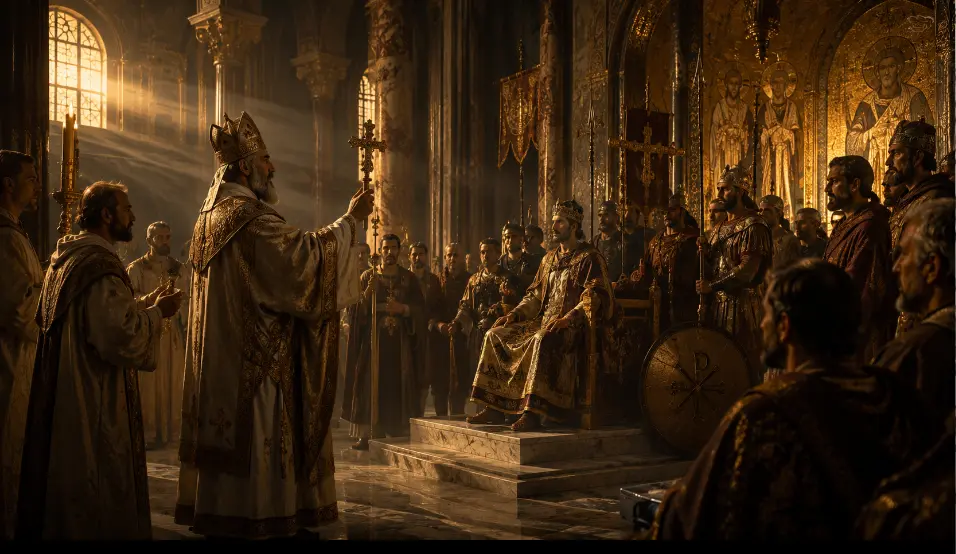
Then came Nicaea.
The Council of Nicaea in 325 was not where the Bible was created. We need to say that plainly. This book is not built on claims that collapse under investigation.
Nicaea was about doctrine, unity, and the controversy surrounding Arius.
But here is what cannot be ignored:
An emperor called the council.
An emperor wanted unity.
An emperor had political reasons to care about religious division.
The council produced the first version of the Nicene Creed, a statement of faith that remains one of the most widely recognized creeds in Christianity.
Constantine called the council to address division, especially the Arian controversy over Christ’s divine status.
That fact matters.
Not because every bishop was corrupt.
Not because every doctrine was false.
Not because Jesus changed.
It matters because the relationship between faith and political power changed.
Christian disagreement was no longer only an internal spiritual matter.
It had become an imperial concern.
So we ask:
If truth is truth, why did disagreement need imperial pressure?
If Christ is Lord, why did Caesar need to help settle the matter?
If the church belonged to God, what happened when the emperor began acting like the manager of its unity?
The questions get sharper after Nicaea.
Constantine later ordered the writings of Arius burned. Most of Arius’s works do not survive independently; what remains is largely preserved through opponents who quoted him while arguing against him.
Pause there.
A theological dispute had moved from debate to destruction.
A teacher’s writings were not only challenged.
They were ordered burned.
So we have to ask:
If a teaching is false, can truth expose it without fire?
If a doctrine is strong, does it need the emperor’s command to survive?
If God is truth, why would truth require the destruction of opposing texts?
That question does not prove Arius was right.
It does not prove Nicaea was wrong.
It proves something else:
Disagreement could become disobedience.
Disobedience could become heresy.
Heresy could become a legal problem.
And once belief becomes a legal problem, truth-seeking enters a different world.
That is where the road keeps moving.
From permission.
To influence.
To councils.
To creeds.
To suppression.
To enforcement.
By 380, under Theodosius, the road had gone much further. The Edict of Thessalonica threatened divine punishment and imperial retribution for those who rejected the Nicene creed.
After Theodosius, the question of religious truth became tied directly to the state.
That is the cold hard truth.
The movement Rome once persecuted became the religion Rome could enforce.
The faith once hunted by power became a faith guarded by power.
And once power guards something, power usually expects influence over what it guards.
That does not prove Jesus false.
It proves men are dangerous when they put their hands on holy things.
It proves empire does not need to invent a faith in order to bend one.
It proves the sword does not have to destroy the cross in order to stand dangerously close to it.
Picture it.
The same empire that once watched Christians suffer now stood beside the church with law in its hand.
The same power that once demanded loyalty to Caesar now helped define the boundaries of acceptable belief.
The same machine that once persecuted the Way now began shaping the institution that claimed to represent it.
It moved closer to the altar.
And once the sword stood near the altar, the next question became unavoidable:
Or was power protecting the version of truth that protected power?
A persecuted faith fights to survive.
A protected faith must fight not to be captured.
That is the danger we must not ignore.