Begin with the record.
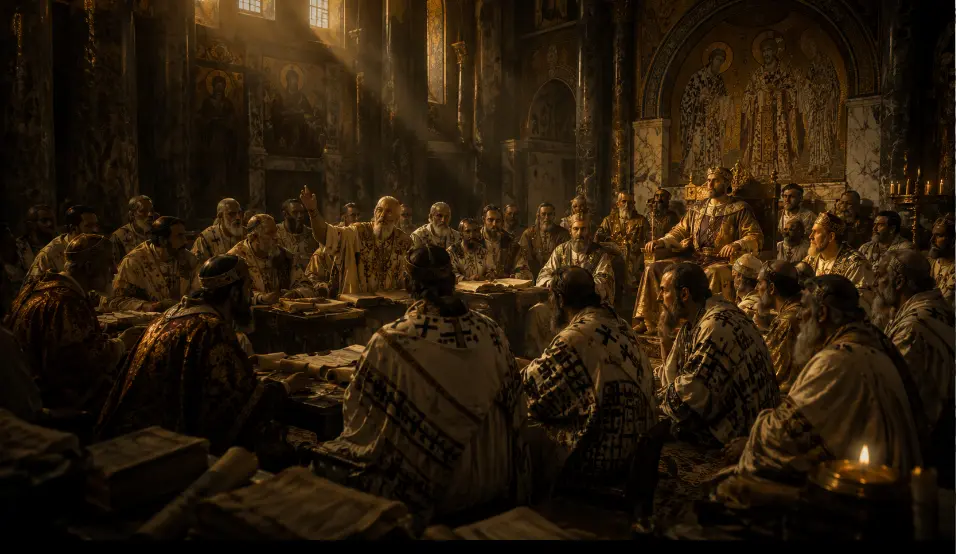
The First Council of Nicaea met in 325 after Constantine called bishops together amid a serious conflict over how Christ related to the Father. Eusebius describes the emperor summoning the assembly and helping bishops travel. Constantine wanted religious agreement and imperial peace; that political interest should not be erased from the story.
Political involvement, however, is not proof that every doctrine was invented in the room. The surviving evidence has to be read claim by claim.
Constantine convened and supported the council.
Eusebius reports an imperial summons, transportation assistance, Constantine’s presence, and the emperor’s stated concern for unity.
The council produced a creed and disciplinary canons.
The preserved materials include the Nicene Creed, twenty canons, and a synodal letter describing action concerning Arius, Meletius, and Easter.
Nicaea marks a dangerous meeting of altar and throne.
This is Project Unveiled’s moral reading of the record. The evidence establishes imperial involvement; the judgment about its spiritual consequences must be argued rather than smuggled in as fact.
How freely did every bishop act?
Sources reveal debate, pressure, agreement, dissent, exile, and later reversal. They do not give us a neutral transcript of every private motive in the room.
What the council did decide.
1. A creed defining the Son’s relationship to the Father
The creed calls the Son “begotten, not made” and uses the Greek term homoousios, commonly rendered “of one substance” with the Father. Its closing condemnation rejects claims that the Son was created, changeable, or once did not exist.
This did not begin Christian belief in Jesus. It drew an official boundary inside an already-existing Christian argument and gave that boundary conciliar and, increasingly, imperial force.
2. Rejection of Arius’s central formulas
The synodal letter says the council examined Arius’s teaching and condemned it. Arius and a small number of holdouts were exiled. A preserved imperial letter also orders Arius’s writings surrendered for destruction. That order is evidence of coercion, but the manuscript history of the letter and the unknown reach of its enforcement should remain visible.
3. Agreement concerning Easter
The council sought a shared observance of Easter. The synodal letter announces agreement on the question, although later practice and calendar history did not become permanently simple.
4. Twenty canons of church discipline
The canons address matters such as ordination, clerical conduct, jurisdiction, reconciliation after persecution, movement of clergy, lending at interest, and worship practice. These rules show that Nicaea was not only a debate over one word in a creed.
What Nicaea did not decide.
It did not create Christianity. It did not invent Jesus. It did not select four Gospels from a pile of competing books. It did not vote the Bible into existence.
The simplest test is direct: inspect the surviving creed, canons, and synodal letter. No biblical canon list appears. Meanwhile, writers before and after 325 discuss acknowledged and disputed writings in ways that show recognition developing across communities and time.
| Claim | What the evidence supports |
|---|---|
| Nicaea created the Bible. | Not supported. The surviving council record contains no canon list or Bible-selection vote. |
| Constantine had no influence. | Not supported. He summoned, funded, attended, encouraged agreement, and enforced consequences. |
| Constantine invented Christianity. | Not supported. Christian communities, Scriptures, worship, and controversies long predate his reign. |
| Nicaea settled every dispute forever. | Not supported. The controversy continued, and imperial and episcopal alignments changed afterward. |
| Nicaea was spiritually unimportant. | Not supported. Its creed and institutional precedent shaped centuries of Christian history. |
Where Project Unveiled presses deeper.
Correcting the Bible myth does not require pretending the council was untouched by power. Constantine’s concern for unity, imperial travel support, the exile of dissenters, and the destruction order all belong in the same honest frame as the theological arguments.
The harder question is not whether bishops met or whether a creed was written. It is this: what happens to a faith when the state gains the power to reward one confession and punish another?
That question cannot be answered by a slogan. It must be followed through 313, 325, 380, later imperial laws, local church practice, and the fruit those alliances produced.
Open the sources.
- First Council of Nicaea: creed, canons, and synodal letter
- Eusebius, Life of Constantine III: imperial summons and Constantine’s account
- Eusebius of Caesarea: letter explaining the creed and homoousios
- Preserved letter of Constantine: order concerning Arius’s writings
- Eusebius, Church History III: accepted and disputed writings