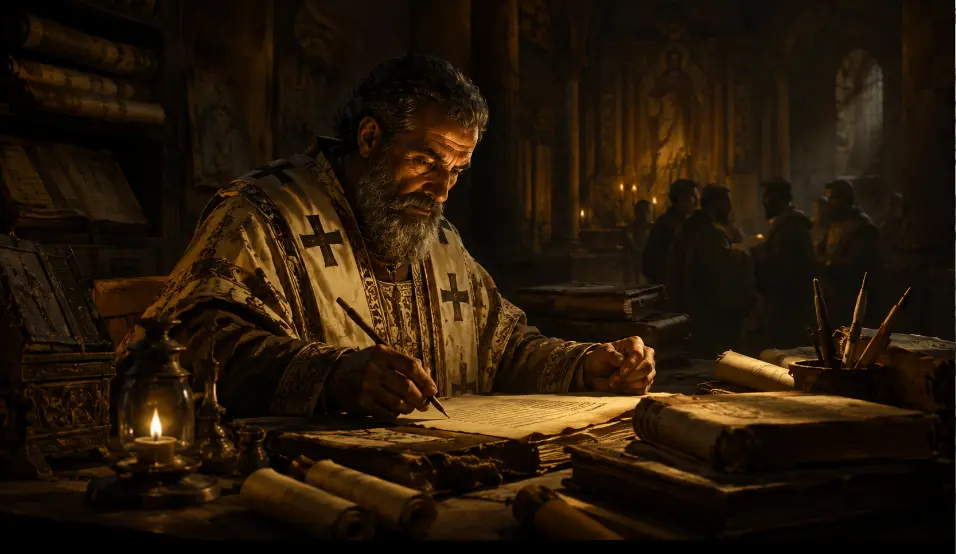
Opening scene: historical dramatization based on the fourth-century Arian controversy. The dialogue is imagined. The tension was real.
The room was not quiet.
It could not be quiet.
Too much was at stake.
Men had come from across the empire carrying more than scrolls, robes, arguments, and titles. Some carried memories of persecution. Some carried wounds from the old world, when Rome had not yet learned to smile beside the cross. Some had seen what imperial pressure could do to a body, a family, a church, a city.
Now the emperor sat close to the argument.
That changed the air.
This was not a small dispute among harmless men.
This was not a polite disagreement over words no one would remember.
This was a battle over Christ.
Who is He?
What is He?
How does the Son relate to the Father?
Was the Son eternal with the Father, or did the Son have a beginning?
Was Christ of the same divine being as the Father, or was He divine in a different, lesser sense?
These were not small questions.
These were questions that could split churches, divide bishops, trouble cities, and shake the unity Constantine wanted for the empire.
Arius stood as a condemned voice to some, but he was not nothing.
He was not a nobody.
He was not an outsider screaming from the edge of the wilderness.
He was a presbyter from Alexandria, connected to the influential Baucalis church, and his teaching had spread widely enough that the dispute reached the imperial level. The issue Constantine expected the bishops to solve at Nicaea was the dispute over Arius and his teaching about Christ.
Across from him stood the force that would become the Nicene future.
Alexander, bishop of Alexandria, had opposed Arius. Near Alexander was a young deacon named Athanasius, not yet the giant he would become, but already standing inside the storm that would shape Christian history.
The argument was not as simple as many people later made it.
Arius did not merely say, “Jesus is nothing.”
Athanasius did not merely say, “Jesus matters.”
Both sides believed they were defending God.
Both sides believed the identity of Christ mattered.
Both Arius and Alexander believed Jesus was the Son of God and divine in some sense; the dispute was over what that divine status meant and how the Son related to the Father.
That is what made the room so dangerous.
The men were not arguing about whether God mattered.
They were arguing about who had understood Him correctly.
And now Rome was listening.
Imagine Arius looking across the room, knowing the tide had turned against him.
Imagine the bishops watching, each man weighing doctrine, loyalty, fear, Scripture, politics, and survival.
Imagine the emperor, not a theologian, not an apostle, not a prophet, but the most powerful man in the Roman world, sitting close enough that every argument carried a shadow.
Arius speaks.
“We are not denying the Son. We are defending the Father.”
His opponents answer.
“You are lowering the Son and dividing the glory of God.”
Arius insists.
“The Father alone is without beginning.”
The Nicene side strikes back.
“If the Son is not truly of the Father’s own being, then what kind of salvation do we have?”
The room tightens.
Words become boundaries.
Boundaries become sides.
Sides become danger.
A line is drawn.
Not with ink only.
With authority.
The creed rises.
Arius falls.
But this is where the seeker must stop and pay attention.
Because the story did not end with argument.
It did not end with correction.
It did not end with one side saying, “We believe Arius is wrong, and here is why.”
After Nicaea, Constantine ordered Arius’s works burned, and one historical summary notes that anyone who refused to surrender copies could face execution.
That is the moment this chapter is built around.
Not because this book is here to prove Arius right.
It is not.
Not because this book is here to prove Athanasius wrong.
It is not.
The question is deeper.
Why did a theological disagreement require fire?
If Arius was false, could truth not answer him?
If his teaching was weak, could examination not expose it?
If Christ is truth, could honest investigation destroy Him?
Or did power fear something else?
That question opens the door to the approved shelf.
A man does not have to burn every book to control what people believe.
Sometimes he only has to decide which books are safe.
Sometimes he only has to decide which voices are dangerous.
Sometimes he only has to make an example out of one voice so future generations learn where not to reach.
This is how the shelf begins.
One accepted voice.
One rejected voice.
One approved teacher.
One condemned teacher.
One safe question.
One forbidden question.
One creed.
One warning.
One law.
One burned writing.
One silenced memory.
And over time, the shelf becomes more than a place where books are kept.
It becomes a border around the mind.
These books are safe.
Those books are dangerous.
These teachers are faithful.
Those teachers are heretics.
These questions are allowed.
Those questions prove rebellion.
And once the people are trained this way, many no longer need their books taken from them.
They stop reaching.
They stop asking.
They stop knocking.
They stop seeking beyond the approved shelf.
That is when a shelf becomes a veil.
Not fabric.
Fear.
Jesus tore the veil.
Men built a shelf.
Then they stood in front of it and said, “Do not look beyond this.”
That is the issue.
Project Unveiled is not built on weak claims.
So let us say this plainly:
The Council of Nicaea did not create the Bible.
That is not our argument.
The canon did not fall out of the sky fully bound in leather, and it was not manufactured in one room by one Roman vote. The formation of the Christian canon was a long process. Some writings were widely received early. Some were disputed. Some were read for instruction. Some were rejected. Different communities handled different texts in different ways before the boundaries hardened.
That historical complexity matters.
Because truth is not helped by sloppy claims.
But another truth stands beside it.
By the fourth century, powerful church leaders were drawing harder lines around what counted as approved Scripture and what did not.
And once empire stood close to those boundaries, the shelf became more than a shelf.
It became a gate.
And once the gate had guards, seekers learned fear.
Athanasius matters here.
He was not a small man.
He became one of the strongest defenders of the Nicene position. He fought fiercely against Arianism. He suffered for his stance. Constantine himself later ordered the first of Athanasius’s five exiles, and the Arian controversy continued for decades with emperors repeatedly intervening in church affairs and doctrine.
So this book will not treat Athanasius like a cartoon villain.
That would be dishonest.
He may have been sincere.
He may have been courageous.
He may have preserved truth in ways that mattered.
But sincerity does not make a man unquestionable.
Courage does not make a man infallible.
And defending truth in one area does not give any man ownership of truth itself.
That is where the shelf becomes dangerous.
In 367, Athanasius wrote his Thirty-Ninth Festal Letter. In that letter, he listed the twenty-seven New Testament books recognized today. Christian History Institute notes that Athanasius stated that in those writings alone “the teaching of godliness is proclaimed,” and that nothing should be added or taken away.
That is historically important.
But the letter did more than list books.
Athanasius also warned against apocryphal books and connected the danger of those writings with heretics misleading the simple. In his own letter, he speaks of heretics, divine Scriptures, apocryphal books, and the danger of believers being led astray by writings resembling the true books.
So we ask:
Was Athanasius preserving truth?
Maybe.
Was he protecting simple believers?
Maybe.
Was he defending the faith from deception?
Maybe.
But we must ask the other side too.
Was he narrowing the search?
Was he placing fear around writings outside his approved boundary?
Was he training believers to see the shelf as the limit of what they were allowed to examine?
Was he a guardian of truth, or a gatekeeper of approved access?
Maybe the answer is not simple.
Maybe he was both.
Maybe he defended something true and still helped build a boundary that later power structures could use.
That is why this chapter does not ask the reader to hate Athanasius.
It asks the reader not to worship him.
Because no man should be trusted with truth in a way that makes questioning him forbidden.
Not Athanasius.
Not Arius.
Not Constantine.
Not Rome.
Not any bishop, council, empire, denomination, scholar, preacher, or system.
Truth belongs to God.
And if Jesus is the truth, then truth does not need to hide behind one man’s shelf.
This is the deeper issue with Arius.
Again, this book is not here to defend Arius’s doctrine.
That is not the purpose.
The purpose is to notice what happens when the winner controls the memory of the loser.
Arius was condemned.
His writings were ordered burned.
Much of what later generations know about Arius comes through his opponents.
That matters.
Because when the winner controls the shelf, the loser is not merely defeated.
The loser is interpreted.
The loser is summarized.
The loser is labeled.
The loser is handed down to history through the voice of the people who buried him.
That does not make the loser right.
But it does make honest seekers careful.
Because truth is not afraid of hearing both sides.
Control is.
And this was not only about Arius.
Arius was one man in a much wider pattern.
Once the machinery of approved belief began to form, many voices were condemned, corrected, exiled, silenced, or buried under the word “heresy.”
Some of those teachings may have been false.
Some may have been confused.
Some may have mixed truth with error.
Some may have carried real danger.
But the seeker must still ask:
Which ones carried warning?
Which ones carried life?
Which ones carried a question the machine could not afford to let the people ask?
Arius forced the question of who gets to define Christ when empire stands in the room.
The Gnostic writings forced the question of inner awakening, hidden knowledge, spiritual blindness, and liberation from deception.
The Gospel of Thomas forced the question of whether sayings attributed to Jesus could speak outside the familiar approved narrative shelf.
Marcion forced the question of canon before the church had fully settled the canon.
Montanism forced the question of whether the Spirit still speaks through unexpected people.
Donatism forced the question of whether compromised religious leaders should retain authority over the wounded.
Priscillian forced the question of when private seeking, apocryphal study, and lay spiritual hunger became dangerous enough to kill.
Manichaeism forced the empire to face a rival spiritual system it could not easily absorb.
Not all of them were right.
That must be said.
Project Unveiled is not a call to swallow every hidden thing just because it was hidden.
It is not a call to replace Jesus.
It is not a call to abandon God.
It is not a call to worship mystery for mystery’s sake.
Now let the idol fall.
Not the living God.
Not Jesus.
Not truth.
The idol.
The man-made thing.
The religious machine.
The approved shelf men built, guarded, decorated, defended, and eventually worshiped as though God Himself had carved it into stone.
That is where this chapter turns.
Because the danger was never only that Arius was condemned.
The danger was what condemnation taught the people.
It taught them that some questions could cost too much.
It taught them that some voices could disappear.
It taught them that some writings could be burned.
It taught them that the safest believer was the quiet believer.
The obedient believer.
The believer who never reached past the shelf.
The believer who accepted the label before hearing the man.
The believer who called fear discernment because fear had been dressed in religious language.
That is not freedom.
That is subjugation with holy paint on it.
That is a curtain called religion.
That is a veil men hung back up after Jesus tore the first one down.
And we have to say it plainly:
A shelf can become an idol.
A creed can become an idol.
A council can become an idol.
A tradition can become an idol.
A preacher can become an idol.
A denomination can become an idol.
A system can become an idol.
Even a good thing can become a false god the moment people bow to it instead of letting it point them back to the True One.
That is how deception works.
It rarely begins by saying, “Reject God.”
It begins by saying, “Trust us more than you seek Him.”
It says, “Stay behind the curtain.”
It says, “Do not look there.”
It says, “Do not ask that.”
It says, “Do not read beyond what we approve.”
It says, “Do not question the men who built the shelf.”
It says, “God is safe here, inside the box we made for Him.”
But the approved shelf becomes a veil whenever its boundaries are defended more fiercely than truth itself.
A shelf can preserve testimony.
It cannot contain the True One.
No council owns Him. No title controls Him. No approved vocabulary exhausts Him.
When a system forbids honest questions, it stops guarding truth and starts guarding itself.
That is the danger we must face next: men can take a boundary built by human hands, hang it between people and God, and call the curtain holy.
The shelf must remain a witness, not an idol.
Let the shelf be examined.
Let the questions come.
Let history speak.
Let the buried voices be weighed.
Let the approved voices be tested.
Let every man, every council, every empire, every bishop, every preacher, every denomination, every tradition, and every system stand under the same light.
Because truth is not afraid of light.
Only idols are.
And when idols fall, people do not have to fall with them.
That is the point.
Project Unveiled is not here to leave people shattered.
It is here to realign them with life.
To call them back to the True One.
To remind them that Jesus is not the machine.
God is not the curtain.
Truth is not the shelf.
The Kingdom is not owned by empire.
And the breath inside a living soul did not come from Rome, councils, bishops, denominations, or religious machinery.
It came from the One.
The True One.
The One whose breath gives life.
So let the false gods fall.
Let the veil tear.
Let the people see.
Let the sleeping believer wake.
Let the seeker seek.
Let the captive remember he was not born for chains.
And let the shelf be judged by the same truth it claimed to protect.