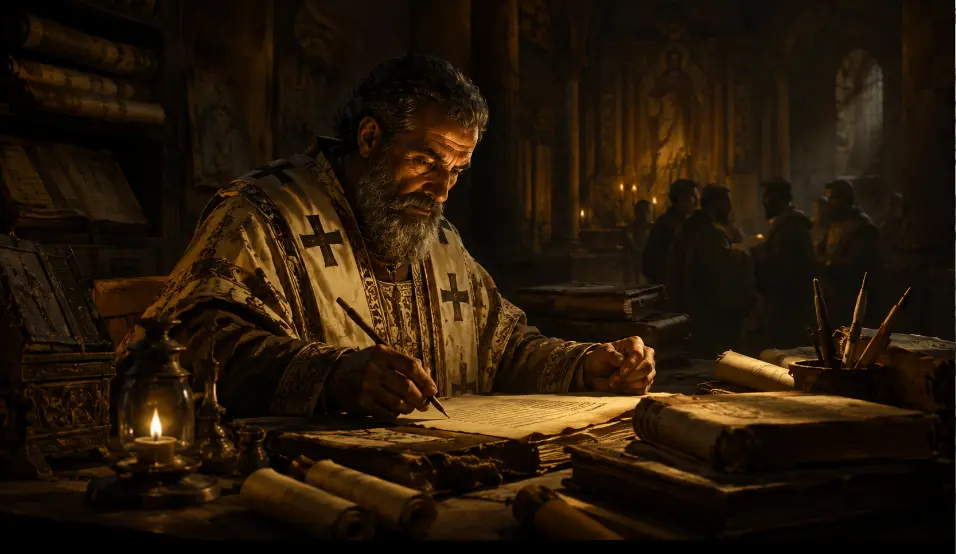
The answer is a process.
“Who chose the Bible?” sounds as if there must be one chooser. The historical evidence points instead to several overlapping questions: Which texts were read in worship? Which were connected to apostles? Which were copied across regions? Which were useful for instruction? Which were treated as a rule for doctrine? Which appeared on a bishop’s list or in a council’s canon?
Those questions did not always receive the same answer at the same time. That is why a precise account separates recognition from later formal definition.
Christians had recognized writings before Constantine.
Early lists and quotations show Gospels, apostolic letters, and other works circulating long before the fourth century, although the edges of the collection were not uniform.
Some books remained disputed.
Eusebius names acknowledged writings and separately discusses James, Jude, 2 Peter, 2 and 3 John, Revelation, and other books whose reception varied.
The shelf can become a veil.
Project Unveiled’s warning is theological: a collection that preserves testimony becomes dangerous when people confuse human custody of the shelf with ownership of God.
How should different Christian canons be described?
New Testament agreement is much wider than Old Testament uniformity. Catholic, Protestant, Orthodox, and Ethiopian traditions do not all inherit identical Old Testament boundaries.
Five stages people often collapse into one.
1. Writing and circulation
Gospels, letters, apocalypses, church orders, homilies, and other writings traveled among early Christian communities. A text’s existence does not prove universal use, and local use does not prove universal canon.
2. Reading and recognition
Some writings were read publicly, copied frequently, cited as authoritative, and connected to apostolic witnesses. Recognition grew through practice before many surviving formal lists appeared.
3. Classification and dispute
Writers tried to describe the evidence they inherited. Eusebius’s categories are especially valuable because he does not pretend every question was settled. He identifies acknowledged books, disputed works recognized by many, and rejected or heretical writings.
4. Lists and regional rulings
Athanasius’s Festal Letter 39 in 367 gives the earliest surviving list that exactly matches the modern twenty-seven-book New Testament. He also names other books suitable for instruction but not included in his canon. Later African councils preserve lists used within their ecclesial setting.
5. Transmission into different traditions
Copying, translation, liturgy, church authority, and eventually printing carried particular collections forward. The result is strong agreement around the New Testament alongside continuing differences in the Old Testament and broader church collections.
A short evidence timeline.
| Period | What the evidence shows |
|---|---|
| Second century | Gospels and apostolic letters circulate and are quoted. The Muratorian Fragment preserves an early canon-like list, though its original date and damaged text remain debated. |
| Early fourth century | Eusebius distinguishes acknowledged, disputed, and rejected writings. The edges of the collection are still visible. |
| 325 | Nicaea addresses creed, Arius, Easter, and discipline. Its surviving documents do not contain a biblical canon decision. |
| 367 | Athanasius lists the same twenty-seven New Testament books used today and separates them from other books appointed for reading. |
| Late fourth and early fifth centuries | Regional synods, including African councils whose canons survive in later collections, formalize lists for church reading and authority. |
| Later centuries | Different Christian traditions transmit overlapping but not completely identical Old Testament collections. |
Why the Nicaea story fails.
The claim that Constantine and the bishops at Nicaea chose the Bible is easy to repeat because it turns a complicated history into one cinematic scene. But a claim this large should leave a trace in the council’s documents. It does not.
The creed contains no book list. The twenty canons contain no book list. The synodal letter contains no book list. Eusebius, who participated in the council and wrote about Constantine, discusses disputed books elsewhere without assigning their settlement to Nicaea.
Rejecting the myth does not require defending every later boundary as perfect. It simply means the investigation begins with what the sources actually say.
What about writings outside the shelf?
“Excluded” can hide several different histories. Some works were used in certain churches but not others. Some were respected for instruction without being treated as canonical. Some appeared too late to persuade most communities of apostolic origin. Some carried theology judged incompatible with the emerging rule of faith. Some survive only in fragments or later copies.
The Nag Hammadi discovery proves that more than fifty late-antique religious and philosophical works were copied and preserved in Coptic codices. It does not, by itself, prove that every work was an original first-century Gospel, that all were suppressed by one council, or that hiddenness guarantees truth.
The responsible path is harder and better: examine each writing’s manuscript evidence, probable date, genre, authorship claims, relation to earlier sources, theology, and fruit.